

Interview with Representative Emily Randall
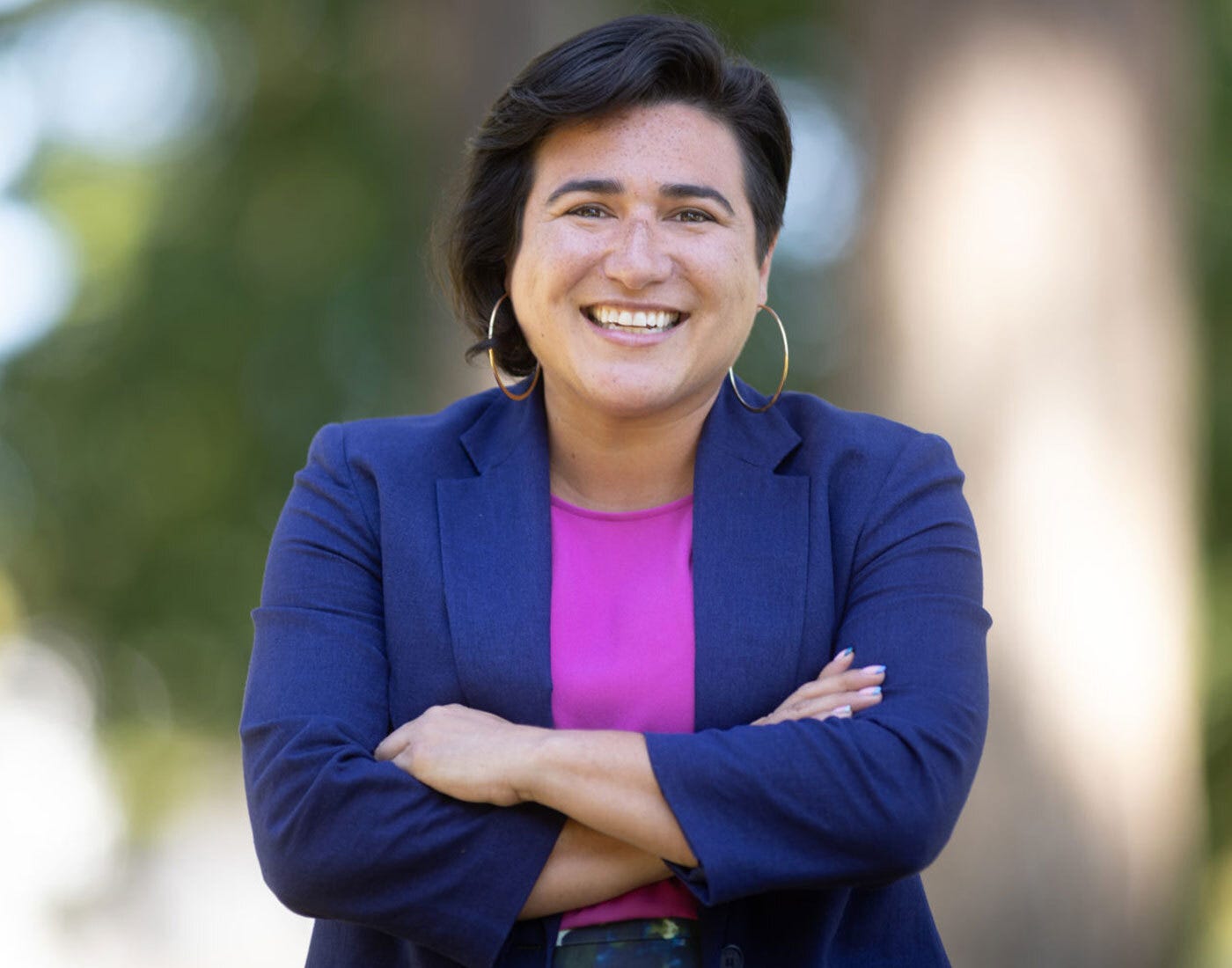
Trailblazing legislator and NDTC alum, Rep. Emily Randall (WA-6), rejoins us for a conversation during Hispanic Heritage Month

TL;DR
Rep. Randall started this work after Trump’s first term, and years later, her community still keeps her going.
Legislating isn’t always glamorous; sometimes it means sleeping in a parking garage instead of jetsetting.
She thinks every first-time candidate should get to know the body they’re running for – before they run for it.
Our mission is to lower barriers to entry for all to make a difference in our communities and government. And this Hispanic Heritage Month, we knew there was one leader (and NDTC learner!) who could speak to this mission from firsthand experience. She’s the first openly queer Latina to join the House of Representatives, and she’s a fighter for accessible healthcare, economic justice, and working families in Washington’s 6th district. Today, we’re highlighting our conversation with Representative Emily Randall, who was generous with her time, inspiring and eye-opening with her stories, and made us laugh with her candor!
NDTC: What inspired you to run for office, what was the biggest thing that drove you to take the first step?
Rep. Randall: Trump’s first election. I didn’t grow up thinking that I was going to run for office or serve in that kind of capacity, but I spent my career after college working in nonprofit spaces, raising money for health care and education for women and kids and LGBTQ folks. And I was at Planned Parenthood at the time of the 2016 election, raising money for their C3, C4, and the Super PAC. And I remember on election night, after months of lead up, feeling like there’s no way I could raise enough private philanthropy dollars to save the health care that I was fighting for, that we had one at the federal and local level that was at risk under this administration. And that’s when I decided to run for the state legislature.
NDTC: What do you love about this work? Either when you started out or now.
Rep. Randall: When I served at the state level I said very regularly that public service is a joy most days, and that’s not how I characterize it anymore. There are definitely still highs amongst the low lows. I love getting to meet with and connect with constituents. I love working with really incredible, dedicated staff. I love problem solving, figuring out how we can make people’s lives better through legislation and well-invested government spending. And you know, all of that is possible because we work together to do it with community members, with colleagues, with staff members. I think about both our democracy, but also good government as a real participation sport. It takes all of us to figure out how to make it serve people better. And that is a joy. That is a joy, even in the hard times.
NDTC: Can you say more about what has changed between being a public servant in Trump’s first term and then while he was out of office and now?
Rep. Randall: Yeah, I think what I love is the same, you know, those human connections, those investments and growing our community and taking care of each other and figuring out how to learn from each other and work together to solve tough problems. There’s also just so much more terribleness to it. You know, I served in a Democratic trifecta, and even then, I knew that my job as a legislative branch constitutional official was to serve the community and hold the executive branch accountable. I understand the way our Constitution works. Twice while I was in office, in six years, the House and Senate Democrats and Republicans in Washington sued our Democratic governor. Not because I didn’t believe in Governor Inslee’s policy positions, but because in our analysis, he overextended his executive authority and it was our duty to hold the executive branch accountable.
We don’t see any of that from Republican colleagues in Congress right now. We see a Constitution that is so often used as a prop, but is not in practice being followed. I see an executive branch that is focused on consolidating power and using people for political pawns, not just the Constitution. And I don’t see members of this president’s party willing to stand up and hold him accountable. And that is really sad and scary and maddening and anxiety-inducing. I know I represent a pretty blue district now, but during my time in the state legislature, I represented a purple one. And I think my constituents, Democrat and Republican, who I’ve talked to over the years at their doors and at community meetings, want a government that functions and want government officials who follow the law.
NDTC: What do you say to yourself on the hard days to keep you going, and keep it worthwhile?
Rep. Randall: I think about my neighbors. I fly home across the country every weekend for the most part. And I do that because my district is big and I need to spend as much time as possible connecting with folks in all six counties. But also because it gives me a lot of strength and resilience to be connected with neighbors who are so committed to taking care of each other. Neighbors who, you know, are collecting diapers so that families who are being impacted by healthcare cuts and SNAP cuts and increased cost of living because of tariffs are able to access diapers for their newborn babies, which help kids stay healthy, but also help postpartum relief, postpartum depression and stress on new families.
I love to connect with educators who are providing space for students to figure out who they are and what they want to be. I was at an apprenticeship program at a school district in Grays Harbor County the other day. And this one student – she’s one of the few girls in this apprenticeship program for advanced manufacturing – she said, it’s this teacher who has believed in me and always asked me what’s wrong and has helped me find not just my voice, but my passion for a job afterwards. And you know, those leaders in our community, those who aren’t elected, are doing such amazing work to protect each other from the harms that federal government is causing. And so that’s who I think of. Those are the conversations I replay for myself in the hard times, like who is being impacted by this administration and how hard are they working to ensure that the impacts don’t hit everyone as hard as they possibly could. And that’s really inspiring to me. There’s no other team I’d rather be on than Washington 6th District.
NDTC: What’s a surprising thing that people may not realize about the job?
Rep. Randall: I mean, it’s not as glamorous as people think it is. I think folks hear about CODELs, meaning Congressional delegations. They hear about, you know, jet-setting members who fly across the country every week. And what they probably don’t imagine is, say you’re trying to take a red eye to DC and the traffic is really bad at the SeaTac exit. And it takes you an hour to get from I-5 to the parking garage so that you miss your flight. You live one to two hours from the airport and the next flight is at 7 AM. So if it’s midnight, maybe the right choice is to pull a blanket over your face and sleep in the car, in the parking garage so that you don’t risk missing another flight … Not that that happened to me in February. But I also have to worry about food going bad in two fridges, and sometimes pack produce in my carry-on because I don’t want the cucumbers to rot and go to waste. I think that’s an example of how we’re all just people trying to do our best for our country and our communities. And we all come with different backgrounds and experiences and are trying to serve.
NDTC: What do you wish you’d known ahead of time?
Rep. Randall: Something that’s really important for candidates and prospective candidates to know, is that the work of getting elected is very different from the work of governing. There are some skills that are certainly transferable, but running for office teaches you almost nothing about the way to pass bills or to serve as an executive or whatever the role is. I think for some people it’s really challenging to pivot from the marketing, the community engagement, the maybe some policy development that you do in order to present your positions. I’ve only ever served in the legislative branch, so I do a lot of coalition-building work. I think both folks who are thinking about running for office and constituents don’t really know very much about what the tools that a legislator has at their disposal are, when they’re in the chamber and doing that work. Yes, it’s also my job to message and inspire and bring people along and show folks what’s happening and to increase transparency and break down barriers for government.
I really love that, but it’s also my job to have one-on-one conversations with colleagues to convince them that my idea is a good one and to solve or respond to their questions and try and get their vote. And I think that’s not how a lot of people imagine the work. If you’re not ready for that kind of collaborative cooperation, then it’s hard to be successful as a legislator.
NDTC: Now, do you think there’s anything that, if you had known with hindsight, you could have done to prepare for that?
Rep. Randall: I had a lot of conversations with state legislators when I was thinking about running and had gotten to know some members of Congress before I ran for this office. I encourage folks to really engage with the body that they’re running for, before they run for it. Like, go to the city council meetings or go to the committee hearing that’s in the legislature, meet with members, not just your own, but members you disagree with and try and expose yourself as much as possible. It’s hard to fit that into a tough campaign year, but if you can beforehand, really figure out how the sausage is made so that you know what to expect, also if you will like it. Because I’ve talked to a lot of folks who were mayors or county executives before running for a legislative position, like in Congress. And that, it sounds like, is a pretty challenging switch to go from being like a decision maker to being a collaborative team member. And I just think it’s better to understand as much as you can about what job you’re running for.
NDTC: Where do you think an organization like NDTC that trains Democrats to run for office fits into our current environment?
Rep. Randall: I think this era in our political reality tells us that more than ever, we need strong and bold and creative and brave leaders. We need leaders who represent their communities, who are diverse in age and race and sexuality and gender and employment background. We need folks who bring new perspectives and who will really stand up and fight for a future that’s better for all of us. And I think I’ve talked to a lot of people who say, “I could never run for office, I don’t know how to do it,” you know. “I could never run for office. I’m not the right kind of person” or “I don’t have these skills” or whatever. And I mean, I took seven candidate trainings before I ran for the state legislature the first time. And I tell people seven is too many. Nobody needs seven. But I do think that having a variety of training, including from NDTC, helped me really understand what I was getting myself into, helped me have technical skills and resources to fall back on and also helped grow my network of people that I could lean on when I had questions, when I had hard days, when I needed to bounce an idea off someone.
That’s powerful too, both as a candidate and once you’re in office – elected officials in other parts of the country who may be dealing with similar problems and have a sense of how to help you get through it. And none of us can do this work alone. So I’m really excited to have the chance to spend some time with you, but also to keep watching what you’re doing as we build not only a bench of incredible leaders of today who better represent our communities, but also the next generation of leaders who are going to help us move into a better future.
Representative Randall’s journey — from nonprofit fundraiser to state legislator to U.S. Congress — proves that there’s no one path to public service, and that preparation and community are pivotal along the way. Whether you’re still considering that run or ready to take the leap, our free courses are designed to give you the hard skills, community, and confidence you need to succeed. Take her advice – don’t start with seven. Everything you need to get going lives in our signature course, So You Think You Want to Run. We’ll take it from there.
P.S. Interested in hearing more from Latino leaders about running for office? Check out the AMA we held last month!
Thank you for reading our latest Substack!
Connect with us everywhere!
Instagram: https://www.instagram.com/traindems/
Facebook: https://www.facebook.com/traindems/
Threads: https://www.threads.net/@traindems
Bluesky: https://bsky.app/profile/traindems.bsky.social
Linkedin: https://www.linkedin.com/company/traindems
Twitter: https://x.com/TrainDems